
Performance Evaluations Should Never Be a Surprise: Why Ongoing Feedback Matters More Than Annual Reviews

For many managers, performance evaluation season is one of the most dreaded times of the year. They scramble to remember what happened over the past twelve months and try to summarize performance in a single document.
For employees, the experience isn’t much better. They anxiously wait to hear what their manager really thinks – and sometimes receive feedback they’ve never heard before.
It doesn’t have to be this way.
The best performance evaluations aren’t annual events. They’re simply a summary of conversations that have been happening all year long.
The Golden Rule: No Surprises
If an employee is surprised by something in their performance evaluation, it’s usually a sign that something went wrong – not during the evaluation, but throughout the year.
Employees should already know:
What they’re doing well.
Where they need to improve.
What success looks like.
Whether they’re meeting expectations.
Whether they’re making progress.
Managers should never wait until the annual review to address performance concerns. Delaying difficult conversations robs employees of the opportunity to improve and often leads to frustration on both sides.
Performance evaluations should validate what employees already know – not introduce new information.

By providing timely feedback throughout the year, managers create an environment where performance evaluations become collaborative about progress, accomplishments, and future development – not difficult discussions about issues the employee is hearing for the first time.
Feedback Given Isn’t Always Feedback Received
One of the biggest mistakes managers make is assuming that because they said something once, the employee understood it, accepted it, and changed their behavior. Unfortunately, that’s not always the case.
Effective feedback is a conversation, not an announcement.
Managers should regularly confirm that employees understand the feedback, ask questions, and discuss what success will look like moving forward.
How do you know feedback isn’t being received? Here are some common signs:
The same issues keep showing up.
The employee can’t clearly explain what’s expected.
The employee agrees in the moment but doesn’t change behavior.
The employee asks for clarification repeatedly.
There is a disconnect between what you expect and what you observe.
If the employee doesn’t understand the expectations or leaves the conversation unsure of what needs to change, the feedback hasn’t really been received.
Those are missed opportunities – and they often result in the very surprises everyone wants to avoid.
Start With Clear Expectations
Before managers can evaluate performance, employees need to understand what is expected of them. Clear expectations should answer questions such as:
What does success look like?
What behaviors are expected?
What quality standards should be met?
How quickly should work be completed?
How should the employee communicate with others?
What level of independence is expected?
Without clearly defined expectations, performance conversations become subjective and inconsistent.
Focus on the Gap
Instead of saying, “Needs improvement,” identify the gap between expectations and performance. Provide specific examples and describe what improvement looks like. Clarity creates fairness and gives employees a roadmap for success.
Adjust Goals When Circumstances Change
Business conditions, shifting priorities, or factors outside of an employee’s control can impact goals. Managers should regularly review goals and expectations and make reasonable adjustments when circumstances change. This ensures goals remain realistic, relevant, and aligned with organizational priorities – while keeping performance conversations fair and motivating.
When Improvement Doesn’t Happen
Most employees want to succeed. When expectations are clear, feedback is timely, and support is provided, positive changes often follow.
If meaningful improvement does not occur despite ongoing coaching and support, it may be time to evaluate whether the issue is an employee’s skill, competence, motivation, or job fit. Sometimes the best decision for the organization – and the employee – is a different role.
A Different Mindset: From Annual Reviews to Ongoing Conversations
Perhaps we’ve been asking the wrong questions all along. Many organizations ask, “How do we write better performance evaluations?” A better question is, “How do we create a culture where annual performance evaluations are no longer necessary?”
Organizations that establish clear expectations, provide regular coaching, confirm that feedback has been understood, adjust goals when business conditions change, and document meaningful conversations throughout the year often find that the annual evaluation becomes little more than a summary of what has already been discussed.
In some organizations, the traditional annual review has been replaced altogether with ongoing performance conversations, periodic check-ins, and continuous coaching. Rather than completing lengthy annual narratives, managers simply document key discussions, accomplishments, and development opportunities throughout the year.
The result is better communication, greater employee engagement, fewer surprises, and improved performance.
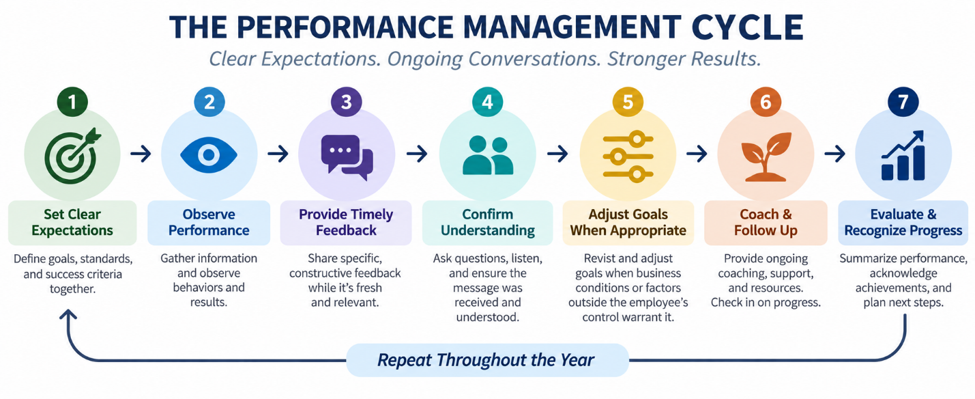
At the end of the day, the goal isn’t to write better performance evaluations. The goal is to help employees succeed.
If your organization could benefit from strengthening its performance management process, we can help. To learn more or schedule a conversation, please contact Edna Nakamoto.


Comments